





Gonzales v. Raich
United States Supreme Court
545 U.S. 1 (2005)
- Written by Jamie Milne, JD
Facts
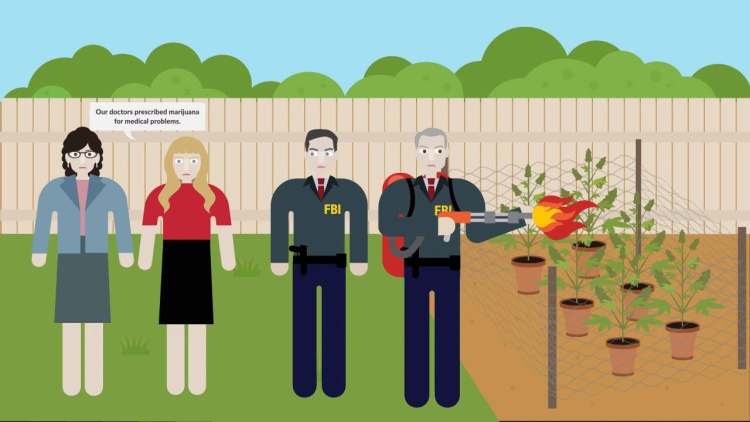
The federal Controlled Substances Act (CSA) categorized drugs into schedules and imposed restrictions for each schedule. Because marijuana was a Schedule I drug, the CSA effectively prohibited its production, distribution, and possession. In 1996, California enacted the Compassionate Use Act, which allowed the use of medicinal marijuana within the state by persons needing marijuana for medical purposes. California residents Angel Raich and Diane Monson (plaintiffs) both used marijuana at their physicians’ recommendation to treat medical issues. Monson cultivated her own marijuana, and Raich obtained locally grown marijuana from her caregivers. The cultivation and possession of marijuana remained illegal under the CSA. Raich and Monson sued Attorney General Alberto Gonzales (defendant), seeking injunctive and declaratory relief prohibiting enforcement of the CSA as to the production or possession of medicinal marijuana within California for personal use. The district court denied Raich’s and Monson’s request for a preliminary injunction. The court of appeals reversed, ordering the district court to enter a preliminary injunction on the basis that, as applied to Raich and Monson, the CSA was an invalid exercise of Congress’s Commerce Clause authority. The United States Supreme Court granted certiorari.
Rule of Law
Issue
Holding and Reasoning (Stevens, J.)
Concurrence (Scalia, J.)
Dissent (Thomas, J.)
Dissent (O’Connor, J.)
What to do next…
Here's why 964,000 law students have relied on our case briefs:
- Written by law professors and practitioners, not other law students. 47,500 briefs, keyed to 1,006 casebooks. Top-notch customer support.
- The right amount of information, includes the facts, issues, rule of law, holding and reasoning, and any concurrences and dissents.
- Access in your classes, works on your mobile and tablet. Massive library of related video lessons and high quality multiple-choice questions.
- Easy to use, uniform format for every case brief. Written in plain English, not in legalese. Our briefs summarize and simplify; they don’t just repeat the court’s language.
- AI-generated podcast version of every brief — listen on the go, between classes, or whenever reading isn’t an option. New
Understand your casebook readings in seconds
Use our case briefs to comprehend your casebook readings faster, supplement your notes and outlines, and outshine your peers in class.
Get instant access to over 47,500+ expert-written case briefs in a searchable database keyed to 1,006 law school casebooks.
