





Kelo v. City of New London
United States Supreme Court
545 U.S. 469, 125 S. Ct. 2655, 162 L. Ed. 2D 439 (2005)
- Written by Megan Petersen, JD
Facts
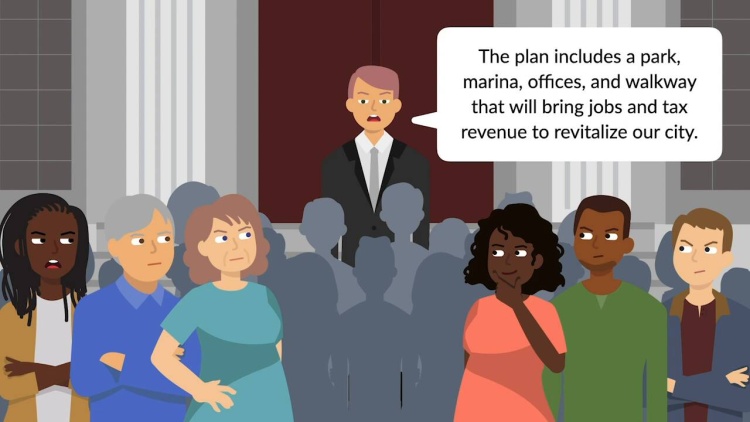
The City of New London, Connecticut (the city) (defendant) suffered decades of economic decline. In 2000, the city approved a new development project intended to create over 1,000 jobs, increase tax revenues, and revitalize the city. The project would result in a new state park, residential properties, and office and commercial spaces. Also, Pfizer, a pharmaceutical giant, agreed to build a new research facility. The project required the acquisition of various private properties in the development area. The city authorized its private developer to purchase properties from those willing to sell and to exercise eminent domain to condemn the properties of unwilling sellers in exchange for just compensation. The developer initiated condemnation proceedings against several properties. The properties, which were in good condition, were condemned solely because of their location. Susette Kelo and eight other unwilling sellers (plaintiffs) sued the city in state court. They argued that the exercise of eminent domain violated the Fifth Amendment’s Takings Clause because the takings were not for a public use but were instead to transfer their private properties to another private party. The state trial court granted an injunction prohibiting the taking of some properties but not others. The Connecticut Supreme Court affirmed in part and reversed in part, holding that all the takings were valid. The United States Supreme Court granted certiorari.
Rule of Law
Issue
Holding and Reasoning (Stevens, J.)
Concurrence (Kennedy, J.)
Dissent (O’Connor, J.)
Dissent (Thomas, J.)
What to do next…
Here's why 964,000 law students have relied on our case briefs:
- Written by law professors and practitioners, not other law students. 47,500 briefs, keyed to 1,006 casebooks. Top-notch customer support.
- The right amount of information, includes the facts, issues, rule of law, holding and reasoning, and any concurrences and dissents.
- Access in your classes, works on your mobile and tablet. Massive library of related video lessons and high quality multiple-choice questions.
- Easy to use, uniform format for every case brief. Written in plain English, not in legalese. Our briefs summarize and simplify; they don’t just repeat the court’s language.
- AI-generated podcast version of every brief — listen on the go, between classes, or whenever reading isn’t an option. New
Understand your casebook readings in seconds
Use our case briefs to comprehend your casebook readings faster, supplement your notes and outlines, and outshine your peers in class.
Get instant access to over 47,500+ expert-written case briefs in a searchable database keyed to 1,006 law school casebooks.
