





Mullane v. Central Hanover Bank & Trust Co.
United States Supreme Court
339 U.S. 306, 70 S. Ct. 652, 94 L. Ed. 865 (1950)
- Written by Jamie Milne, JD
Facts
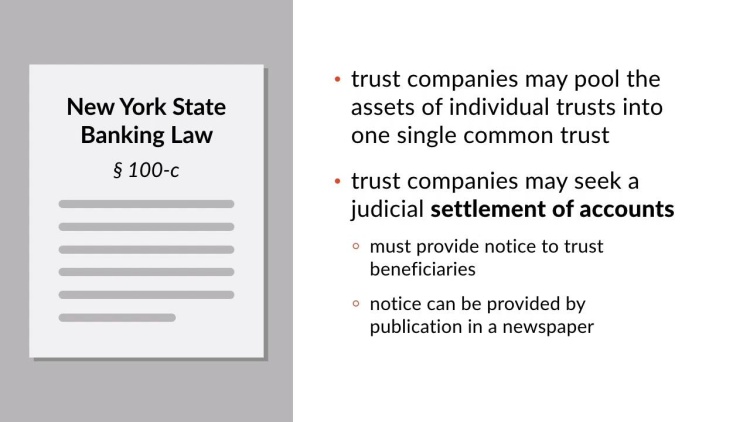
Central Hanover Bank and Trust Company (Hanover) (plaintiff) established a common trust fund. A common trust fund pools multiple small trusts into one large, collective trust for easier administration, with the collective trust’s income and expenses being allocated proportionally among the constituent trusts. Hanover was required to make periodic accountings. Once an accounting was settled, Hanover’s decisions for that period could not be challenged. When Hanover petitioned a New York court for settlement of its first accounting, interested parties were given notice only by publication in a local newspaper, which complied with the minimum requirements under New York banking law. At the time, there were 113 small trusts in the common trust. Hanover had addresses for some interested persons, particularly the income beneficiaries to whom income was currently being paid. However, Hanover lacked information regarding other potentially interested persons. Some beneficiaries were New York residents, and others were out-of-state residents. The court appointed Mullane (defendant) as special guardian of persons known or unknown who might have an interest in the common trust’s income. Mullane objected that the notice by publication was inadequate to satisfy Fourteenth Amendment due process. The court nonetheless entered a final decree accepting the accounts. The state’s appellate court and highest court affirmed. Mullane appealed to the United States Supreme Court.
Rule of Law
Issue
Holding and Reasoning (Jackson, J.)
What to do next…
Here's why 964,000 law students have relied on our case briefs:
- Written by law professors and practitioners, not other law students. 47,500 briefs, keyed to 1,006 casebooks. Top-notch customer support.
- The right amount of information, includes the facts, issues, rule of law, holding and reasoning, and any concurrences and dissents.
- Access in your classes, works on your mobile and tablet. Massive library of related video lessons and high quality multiple-choice questions.
- Easy to use, uniform format for every case brief. Written in plain English, not in legalese. Our briefs summarize and simplify; they don’t just repeat the court’s language.
- AI-generated podcast version of every brief — listen on the go, between classes, or whenever reading isn’t an option. New
Understand your casebook readings in seconds
Use our case briefs to comprehend your casebook readings faster, supplement your notes and outlines, and outshine your peers in class.
Get instant access to over 47,500+ expert-written case briefs in a searchable database keyed to 1,006 law school casebooks.
