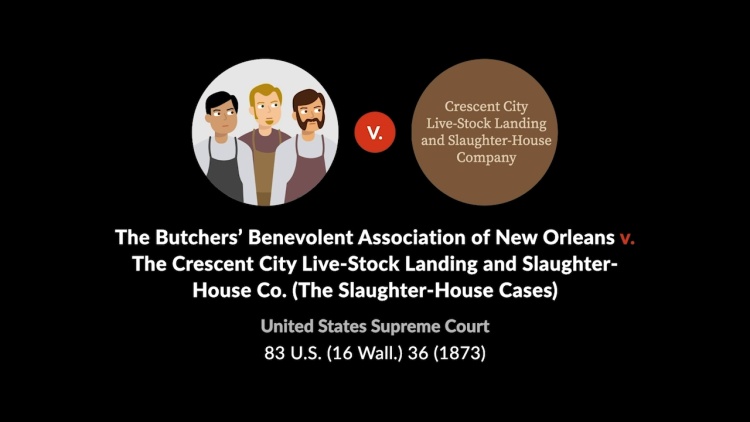
Slaughter House Cases: Butchers’ Benevolent Association of New Orleans v. Crescent City Livestock Landing & Slaughter-house Co.
United States Supreme Court
83 U.S. (16 Wall.) 36, 21 L. Ed. 394 (1873)
- Written by Megan Petersen, JD
Facts
New Orleans faced severe outbreaks of disease after its water supply was contaminated with slaughterhouse refuse. In response, the Louisiana legislature decided to centralize all slaughtering operations away from the city’s water supply. It enacted a statute creating the Crescent City Livestock Landing & Slaughter-house Co. (company) (defendant) and giving it a monopoly over the entire slaughtering business in and around New Orleans. The statute required the company to construct and operate facilities in a specified location. Local butchers could slaughter and butcher their own meats but were required to do so at the company’s facilities for a fee. The Butchers’ Benevolent Association of New Orleans (plaintiff) brought several suits against the company. It alleged that by limiting butchers’ ability to practice their trade, the Louisiana statute ran afoul of the Thirteenth Amendment’s servitude prohibition and the Fourteenth Amendment’s Privileges or Immunities Clause, Due Process Clause, and Equal Protection Clause. The Louisiana Supreme Court held in the company’s favor. The United States Supreme Court granted certiorari.
Rule of Law
Issue
Holding and Reasoning (Miller, J.)
What to do next…
Here's why 955,000 law students have relied on our case briefs:
- Written by law professors and practitioners, not other law students. 47,500 briefs, keyed to 1,006 casebooks. Top-notch customer support.
- The right amount of information, includes the facts, issues, rule of law, holding and reasoning, and any concurrences and dissents.
- Access in your classes, works on your mobile and tablet. Massive library of related video lessons and high quality multiple-choice questions.
- Easy to use, uniform format for every case brief. Written in plain English, not in legalese. Our briefs summarize and simplify; they don’t just repeat the court’s language.
- AI-generated podcast version of every brief — listen on the go, between classes, or whenever reading isn’t an option. New