Williams v. Walker-Thomas Furniture Co.
United States Court of Appeals for the District of Columbia Circuit
350 F.2d 445, 121 U.S. App. D.C. 315 (1965)
- Written by Angela Patrick, JD
Facts
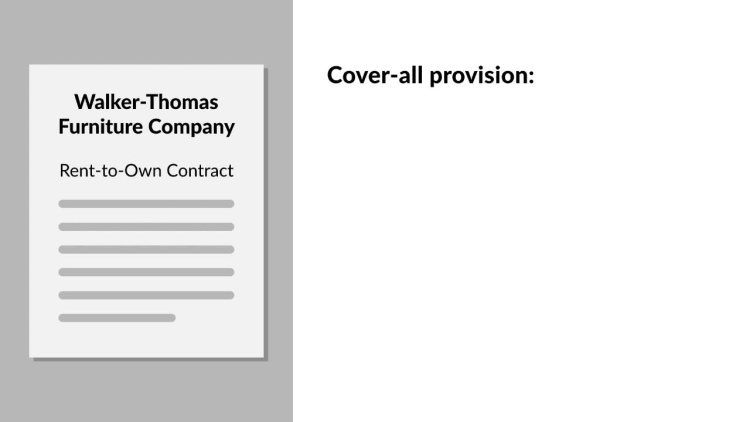
Walker-Thomas Furniture Co. (Walker) (plaintiff) sold furniture and household appliances on credit, using installment contracts. Walker’s contracts contained a cover-all provision, written in small print. Using legalese, this provision essentially stated that the balance for any new purchase would be combined with the customer’s balances on all prior purchases and that each installment payment would be applied across the customer’s entire balance. This provision meant that no individual item was fully paid off until the customer paid the entire amount for all items. If a customer defaulted on any purchase, Walker could repossess every item the customer had purchased from the store. Ora Lee Williams (defendant), a single mother of seven children, lived on $218 per month. Over five years, Williams purchased 14 items from Walker on credit. Williams did not read the contracts and believed she was paying off the items in the order she had purchased them. Williams had reduced her total balance to $164 when Walker sold her a stereo for $514, fully aware of her financial situation. Williams later defaulted, and Walker sued for a writ of replevin. The trial court granted the writ, and Walker repossessed all the furniture and appliances Williams had purchased, even though she had repaid the full purchase price for most of them. The District of Columbia Court of Appeals affirmed the seizures, finding that unconscionability alone did not prevent enforcement of a contract. Williams appealed to the United States Court of Appeals for the District of Columbia Circuit, where her case was consolidated with a similar case involving other Walker customers.
Rule of Law
Issue
Holding and Reasoning (Skelly Wright, J.)
Dissent (Danaher, J.)
What to do next…
Here's why 966,000 law students have relied on our case briefs:
- Written by law professors and practitioners, not other law students. 47,500 briefs, keyed to 1,007 casebooks. Top-notch customer support.
- The right amount of information, includes the facts, issues, rule of law, holding and reasoning, and any concurrences and dissents.
- Access in your classes, works on your mobile and tablet. Massive library of related video lessons and high quality multiple-choice questions.
- Easy to use, uniform format for every case brief. Written in plain English, not in legalese. Our briefs summarize and simplify; they don’t just repeat the court’s language.
- AI-generated podcast version of every brief — listen on the go, between classes, or whenever reading isn’t an option. New
Understand your casebook readings in seconds
Use our case briefs to comprehend your casebook readings faster, supplement your notes and outlines, and outshine your peers in class.
Get instant access to over 47,500+ expert-written case briefs in a searchable database keyed to 1,007 law school casebooks.