



Play video

Holder in Due Course: Without Notice

Learn about the requirement that, to be a holder in due course, the holder must take the instrument without notice of certain problems with the instrument.

Transcript

As you may recall from another lesson, to attain holder-in-due-course status, a person must be the instrument’s holder, take the instrument for value and in good faith, and take the instrument without notice of various problems affecting the instrument’s enforceability.

We’ve already discussed the first three requirements; now, let’s look at the last one.

I. Taking without Notice

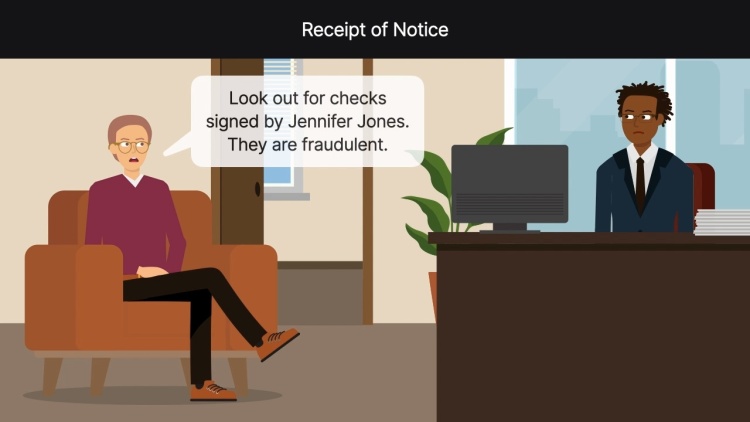
To be a holder in due course, the holder must take the instrument without notice of various problems affecting the...

Lessons

1. Welcome
  • Welcome to Payment Systems
2. Negotiability
  • Introduction to Negotiable Instruments
  • Negotiability Requirements I
  • Negotiability Requirements II
  • Rule against Additional Terms
3. Key Terms in Article 3
  • Key Terms I
  • Key Terms II
  • Becoming a Holder
  • Negotiation
  • Indorsement
4. Enforcement of Negotiable Instruments
  • Holder in Due Course: Value and Good Faith
  • Holder in Due Course: Without Notice
  • Close-Connectedness Doctrine and Shelter Rule
  • Defenses against Enforcement
5. Liability on Negotiable Instruments
  • Obligations of the Parties
  • Instruments Taken for an Obligation
  • Accord and Satisfaction Using a Negotiable Instrument
  • Enforcement of Lost, Stolen, or Destroyed Instruments
  • Warranty Liability
6. Dishonor, Payment, and Discharge
  • Dishonor of Negotiable Instruments
  • Payment of Negotiable Instruments
  • Discharge of Liability
7. Misconduct and Mistake
  • Unauthorized Signatures and Alterations
  • The Negligence Rule
  • Imposters and Fictitious or Unintended Payees
  • Conversion of a Negotiable Instrument
8. Bank Deposits and Collections
  • Introduction to Article 4
  • Collection: Depositary and Collecting Banks
  • Collection: Payor Banks
  • Payor Bank’s Relationship to Its Customers