



Play video

Holder in Due Course: Value and Good Faith

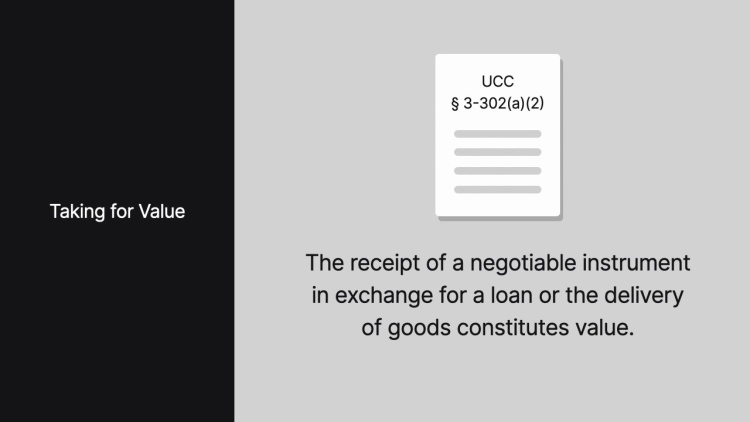
Learn about the requirement that, to be a holder in due course, the holder must take the instrument for value and in good faith.

Transcript

If a person is entitled to enforce, that is, collect on a negotiable instrument and chooses to do so, the ease of such enforcement depends on whether the person seeking enforcement is a holder in due course.

Unlike a mere holder, a holder in due course takes the instrument free of most defenses and competing claims. Thus, it’s nearly impossible to prevent a holder in due course from collecting on the instrument.  

In this and the next several lessons, we’ll explore how one attains...

Lessons

1. Welcome
  • Welcome to Payment Systems
2. Negotiability
  • Introduction to Negotiable Instruments
  • Negotiability Requirements I
  • Negotiability Requirements II
  • Rule against Additional Terms
3. Key Terms in Article 3
  • Key Terms I
  • Key Terms II
  • Becoming a Holder
  • Negotiation
  • Indorsement
4. Enforcement of Negotiable Instruments
  • Holder in Due Course: Value and Good Faith
  • Holder in Due Course: Without Notice
  • Close-Connectedness Doctrine and Shelter Rule
  • Defenses against Enforcement
5. Liability on Negotiable Instruments
  • Obligations of the Parties
  • Instruments Taken for an Obligation
  • Accord and Satisfaction Using a Negotiable Instrument
  • Enforcement of Lost, Stolen, or Destroyed Instruments
  • Warranty Liability
6. Dishonor, Payment, and Discharge
  • Dishonor of Negotiable Instruments
  • Payment of Negotiable Instruments
  • Discharge of Liability
7. Misconduct and Mistake
  • Unauthorized Signatures and Alterations
  • The Negligence Rule
  • Imposters and Fictitious or Unintended Payees
  • Conversion of a Negotiable Instrument
8. Bank Deposits and Collections
  • Introduction to Article 4
  • Collection: Depositary and Collecting Banks
  • Collection: Payor Banks
  • Payor Bank’s Relationship to Its Customers