



Play video

The Rule of Reason

Learn about the case-by-case reasonableness evaluation of restrictive conduct.

Transcript

In this lesson, we’ll learn about the case-by-case reasonableness evaluation of restrictive conduct. 

I.               The Rule of Reason

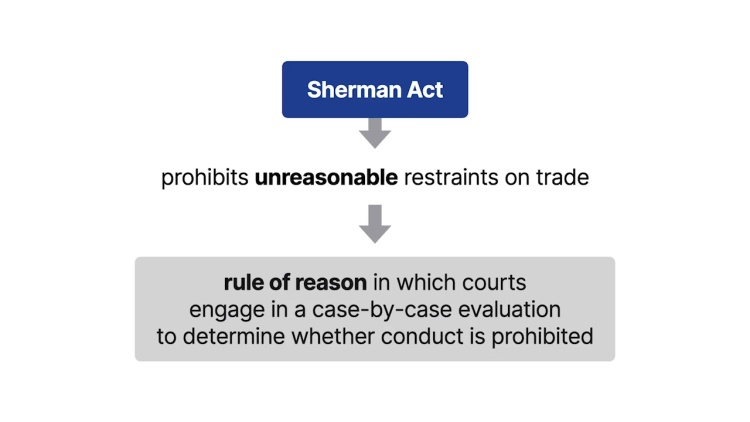
Since the earliest days of federal antirust jurisprudence, the U.S. Supreme Court has interpreted the Sherman Act to prohibit only unreasonable restraints on trade. That means there’s a rule of reason in which courts, in deciding whether horizontal conduct violates § 1 of the Sherman...

Lessons

1. Welcome to Antitrust
  • Welcome to Antitrust
2. The Origins and Economics of Antitrust Law
3. The Scope of Antitrust Law
  • Interstate Commerce, Overseas Commerce, and Organized Labor
  • State Action
  • First Amendment and Other Immunities
4. Horizontal Restraints
  • Defining the Market
  • Horizontal Agreements
  • Per Se Violations
  • The Rule of Reason
5. Vertical Restraints
  • Vertical Agreements
  • Resale Price Maintenance
  • Vertical Market Allocation
  • Tying Arrangements
  • Exclusive Dealing
6. Monopolization
  • Monopolies and Monopolization
  • Monopolistic Practices
  • Monopolization, Attempted Monopolization, and Conspiracy to Monopolize
7. Price Discrimination
  • Pure Price Discrimination
  • Brokerage Practices and Promotional Allowance Discrimination
  • Liability and Affirmative Defenses
8. Mergers and Antitrust Enforcement
  • Mergers
  • Merger Review
  • Antitrust: Private Rights of Action
  • Antitrust: Public Enforcement
9. Global Competition Law and Patents
  • Global Competition Law
  • Patents
  • Patent Licensing