



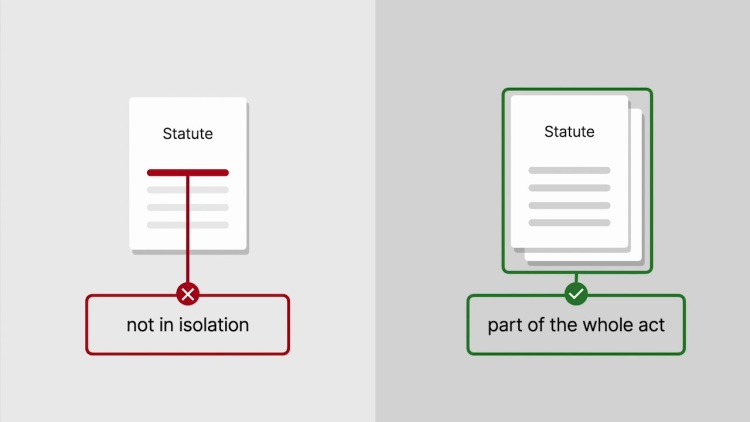
Play video

Canons of Statutory Interpretation I

Learn about interpretive canons, “plain and ordinary meaning” canons, and primary canons regarding semantics, syntax, and grammar.

Transcript

I. Introduction

Canons are odd legal ducks. Most of the time, they’re not adopted by a legislature or deliberative body, so they’re not statutes, constitutions, or promulgated rules. They’re not substantive or binding legal principles adopted by courts, so they don’t neatly qualify as common-law doctrines. Black’s Law Dictionary defines a canon as a rule or principle accepted as fundamental. Canons of construction are often considered customs that don’t actually have the force of law. Yet many...

Lessons

1. Welcome
  • Welcome
2. Federal Systems of Legislation & Regulation
  • The Federal Constitutional System of Legislation and Regulation
  • Overview of Sources of Federal Law
  • The Constitution and Legislative Power
3. Federal Legislative Processes
  • How a Bill Becomes a Law
  • Delegation of Congressional Lawmaking Power to Agencies I
  • Delegation of Congressional Lawmaking and Judicial Power to Agencies II
4. Statutory Interpretation
  • Philosophical Views of the Judiciary’s Role and Common Interpretive Problems
  • Differing Theories of Statutory Interpretation
  • Legislative History and its Use in Interpreting Statutes
  • Canons of Statutory Interpretation I
  • Canons of Statutory Interpretation II
  • Canons of Statutory Interpretation III
  • Canons of Statutory Interpretation IV
5. Agency Action, State Processes, & Courts
  • The History and Evolution of the Administrative State
  • Federal Regulatory Processes
  • Executive Branch Control of Agencies and Judicial Review of Agency Action
  • Judicial Review of Agency Action Under the APA
  • State Legislative & Administrative Processes
  • Judicial Process