



Play video

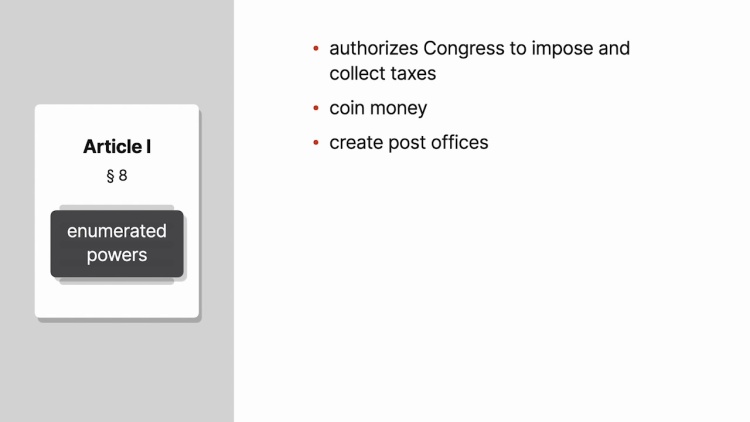
The Constitution and Legislative Power

Learn about Constitutional limitations on Congressional authority, the Supreme Court’s expansive view of Congressional authority, and the Civil War Amendments and other expansion of Congressional authority.

Transcript

I. Introduction

If one compares Congress’s output of legislation over the nation’s first century-and-a-half to Congress’s output since the end of World War II, a huge difference becomes apparent. Congress legislated on comparatively little in the years leading to the Civil War, then, after a flurry of legislation immediately after that war, slowed down again. Congress’s output rose during the 1890s, then expanded significantly in response to the Great Depression, which started in 1929. After...

Lessons

1. Welcome
  • Welcome
2. Federal Systems of Legislation & Regulation
  • The Federal Constitutional System of Legislation and Regulation
  • Overview of Sources of Federal Law
  • The Constitution and Legislative Power
3. Federal Legislative Processes
  • How a Bill Becomes a Law
  • Delegation of Congressional Lawmaking Power to Agencies I
  • Delegation of Congressional Lawmaking and Judicial Power to Agencies II
4. Statutory Interpretation
  • Philosophical Views of the Judiciary’s Role and Common Interpretive Problems
  • Differing Theories of Statutory Interpretation
  • Legislative History and its Use in Interpreting Statutes
  • Canons of Statutory Interpretation I
  • Canons of Statutory Interpretation II
  • Canons of Statutory Interpretation III
  • Canons of Statutory Interpretation IV
5. Agency Action, State Processes, & Courts
  • The History and Evolution of the Administrative State
  • Federal Regulatory Processes
  • Executive Branch Control of Agencies and Judicial Review of Agency Action
  • Judicial Review of Agency Action Under the APA
  • State Legislative & Administrative Processes
  • Judicial Process