



Play video

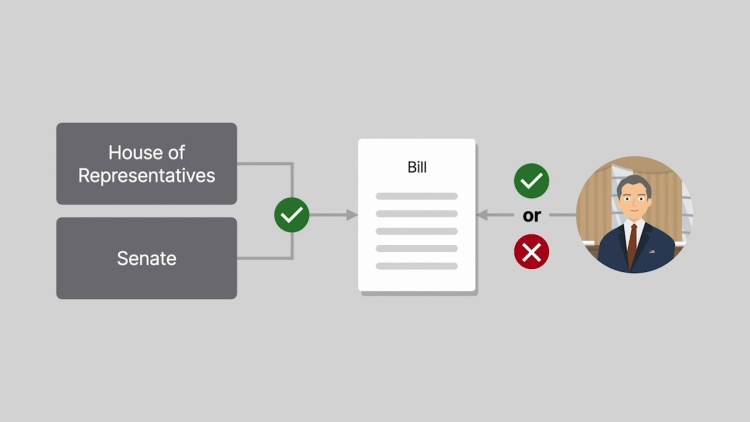
How a Bill Becomes a Law

Learn about the Constitutional, political, partisan, and administrative processes involved in passing legislation.

Transcript

I. Introduction

Proposed legislation faces an uphill battle to become actual law. During the five congressional sessions between 2011 and 2020, only 4 to 7 percent of the bills submitted were enacted into law. One author has commented that the lawmaking process is, quote, “filled with opportunities for opponents of [proposed] legislation to obstruct its passage,” unquote.

The Constitution lays out certain requirements for enacting legislation. Each house also has its own rules and customs, and...

Lessons

1. Welcome
  • Welcome
2. Federal Systems of Legislation & Regulation
  • The Federal Constitutional System of Legislation and Regulation
  • Overview of Sources of Federal Law
  • The Constitution and Legislative Power
3. Federal Legislative Processes
  • How a Bill Becomes a Law
  • Delegation of Congressional Lawmaking Power to Agencies I
  • Delegation of Congressional Lawmaking and Judicial Power to Agencies II
4. Statutory Interpretation
  • Philosophical Views of the Judiciary’s Role and Common Interpretive Problems
  • Differing Theories of Statutory Interpretation
  • Legislative History and its Use in Interpreting Statutes
  • Canons of Statutory Interpretation I
  • Canons of Statutory Interpretation II
  • Canons of Statutory Interpretation III
  • Canons of Statutory Interpretation IV
5. Agency Action, State Processes, & Courts
  • The History and Evolution of the Administrative State
  • Federal Regulatory Processes
  • Executive Branch Control of Agencies and Judicial Review of Agency Action
  • Judicial Review of Agency Action Under the APA
  • State Legislative & Administrative Processes
  • Judicial Process