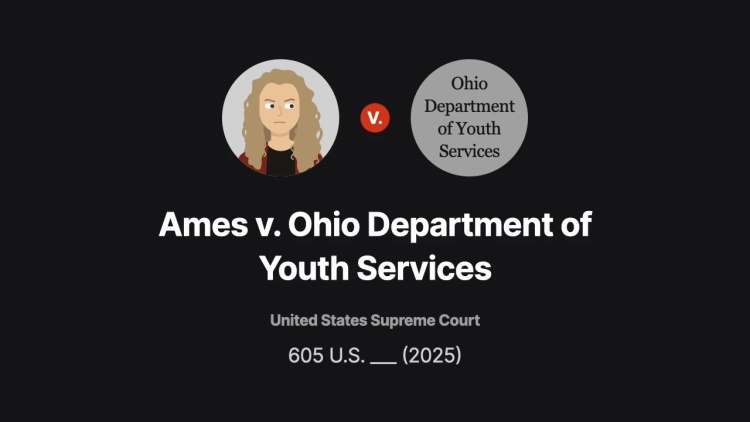
Ames v. Ohio Department of Youth Services
United States Supreme Court
605 U.S. ___ (2025)
- Written by Abby Roughton, JD
Facts
Marlean Ames (plaintiff), a heterosexual woman, began working for the Ohio Department of Youth Services (the agency) (defendant) in 2004. In 2019, Ames interviewed for a promotion to a management position, but the agency ultimately hired a lesbian woman for the position. Later, the agency demoted Ames and hired a gay man to fill Ames’s previous position. Ames sued the agency in federal district court in Ohio under Title VII of the Civil Rights Act of 1964, asserting that the agency had denied her the management position and demoted her based on her sexual orientation. The district court analyzed Ames’s claim using the burden-shifting framework set forth in McDonnell Douglas Corp. v. Green, the first prong of which required Ames to make a prima facie showing that the agency had acted with a discriminatory motive. However, under Sixth Circuit precedent, because Ames was a member of a majority group (i.e., a heterosexual person), the court required Ames to make an additional showing of background circumstances to support a suspicion that the agency was an atypical employer that discriminated against the majority. The court found that Ames had not shown such background circumstances and thus had not met her burden. Accordingly, the court granted summary judgment for the agency. The court of appeals affirmed, and the United States Supreme Court granted certiorari to resolve a circuit split regarding whether majority-group plaintiffs must satisfy a higher evidentiary standard than minority-group plaintiffs.
Rule of Law
Issue
Holding and Reasoning (Jackson, J.)
Concurrence (Thomas, J.)
What to do next…
Here's why 964,000 law students have relied on our case briefs:
- Written by law professors and practitioners, not other law students. 47,500 briefs, keyed to 1,006 casebooks. Top-notch customer support.
- The right amount of information, includes the facts, issues, rule of law, holding and reasoning, and any concurrences and dissents.
- Access in your classes, works on your mobile and tablet. Massive library of related video lessons and high quality multiple-choice questions.
- Easy to use, uniform format for every case brief. Written in plain English, not in legalese. Our briefs summarize and simplify; they don’t just repeat the court’s language.
- AI-generated podcast version of every brief — listen on the go, between classes, or whenever reading isn’t an option. New
Understand your casebook readings in seconds
Use our case briefs to comprehend your casebook readings faster, supplement your notes and outlines, and outshine your peers in class.
Get instant access to over 47,500+ expert-written case briefs in a searchable database keyed to 1,006 law school casebooks.