Anderson v. Zamir
Illinois Appellate Court
931 N.E.2d 697 (2010)
- Written by Jamie Milne, JD
Facts
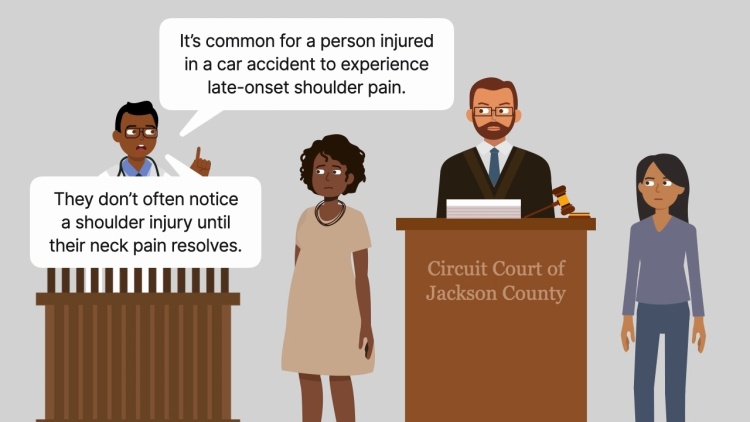
While driving, Saadia Zamir (defendant) rear-ended college student Tiffany Anderson (plaintiff). Later that day, Anderson went to the hospital complaining of back pain on her left side. She was prescribed pain medication and a neck brace. Follow-up visits at the student health center resulted in additional pain medication and six months of physical therapy. Almost a year after the accident, Anderson returned to the student health center complaining of shoulder pain. An orthopedic specialist identified a tear in the labrum of her left shoulder, requiring surgery and more physical therapy. After the surgery, Anderson sued Saadia and her husband, Saeed (defendant), seeking damages for her back and shoulder injuries. The Zamirs admitted liability, meaning the trial was purely to determine appropriate damages. Two doctors testified that despite the delay in symptoms, the shoulder injury was likely caused by the accident. The Zamirs did not offer any evidence impeaching the doctors’ testimony. On cross-examination, however, the Zamirs’ attorney suggested that Anderson should recover damages for her back injury only. Anderson’s medical bills from the back and shoulder injuries totaled $28,804. However, the trial-court jury awarded her only $12,500, $5,000 for medical bills and $7,500 for pain and suffering. After the trial court denied Anderson’s motion for a new trial, Anderson appealed to the Illinois Appellate Court, contesting the validity of the jury’s damages award.
Rule of Law
Issue
Holding and Reasoning (Chapman, J.)
What to do next…
Here's why 955,000 law students have relied on our case briefs:
- Written by law professors and practitioners, not other law students. 47,500 briefs, keyed to 1,006 casebooks. Top-notch customer support.
- The right amount of information, includes the facts, issues, rule of law, holding and reasoning, and any concurrences and dissents.
- Access in your classes, works on your mobile and tablet. Massive library of related video lessons and high quality multiple-choice questions.
- Easy to use, uniform format for every case brief. Written in plain English, not in legalese. Our briefs summarize and simplify; they don’t just repeat the court’s language.
- AI-generated podcast version of every brief — listen on the go, between classes, or whenever reading isn’t an option. New