Automotive Parts & Accessories Association v. Boyd
United States Court of Appeals for the District of Columbia Circuit
407 F.2d 330 (1968)
- Written by Robert Cane, JD
Facts
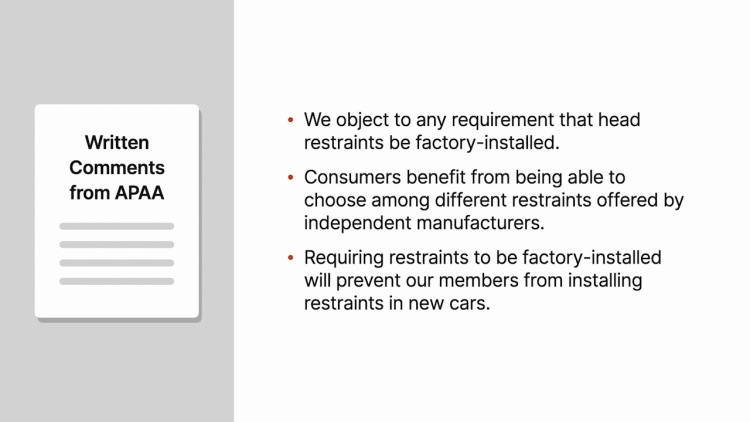
Congress enacted a motor-vehicle-safety law, delegating to the secretary of transportation the power to issue safety standards for motor vehicles. Both the House and Senate versions of the law expressly stated that Section 553 of the Administrative Procedure Act (APA) would apply to the rulemaking process and that formal procedures would be required only if the secretary of transportation deemed them appropriate. The secretary of transportation, Boyd (defendant), used this power to propose a rule that would require all new passenger cars to be factory-equipped with front-seat head restraints. Written comments on the proposed rule were solicited multiple times. In between comment periods, a meeting for interested parties was held to provide an opportunity for them to voice concerns or propose changes to the rule. Ultimately, the changes proposed by interested parties, including Sterling Products Co., Inc.; Automotive Parts & Accessories Association, Inc.; and Automotive Service Industry Association (the auto companies) (plaintiffs), were rejected. The auto companies filed petitions for reconsideration, which were denied. The auto companies did not want the safety standard to require factory installation of the head restraints. Instead, they wanted motor-vehicle purchasers to be able to choose which head restraints to install after purchasing a new vehicle because factory installation would have an adverse impact on the auto-accessory business. However, the auto companies argued that the reason they resisted the new standard was to protect consumers. In the promulgation of the final standard, the Department of Transportation’s administrator directly addressed the auto companies’ objections to the new rule and petitions for reconsideration, essentially stating that factory-equipped head restraints would be safer and more effective. The auto companies filed suit in district court, petitioning for review of the new rule, which was denied. The industry group appealed to United States Court of Appeals for the District of Columbia Circuit.
Rule of Law
Issue
Holding and Reasoning (McGowan, J.)
What to do next…
Here's why 955,000 law students have relied on our case briefs:
- Written by law professors and practitioners, not other law students. 47,500 briefs, keyed to 1,006 casebooks. Top-notch customer support.
- The right amount of information, includes the facts, issues, rule of law, holding and reasoning, and any concurrences and dissents.
- Access in your classes, works on your mobile and tablet. Massive library of related video lessons and high quality multiple-choice questions.
- Easy to use, uniform format for every case brief. Written in plain English, not in legalese. Our briefs summarize and simplify; they don’t just repeat the court’s language.
- AI-generated podcast version of every brief — listen on the go, between classes, or whenever reading isn’t an option. New