





Benya v. Stevens & Thompson Paper Co.
Vermont Supreme Court
143 Vt. 521 (1983)
- Written by Noah Lewis, JD
Facts
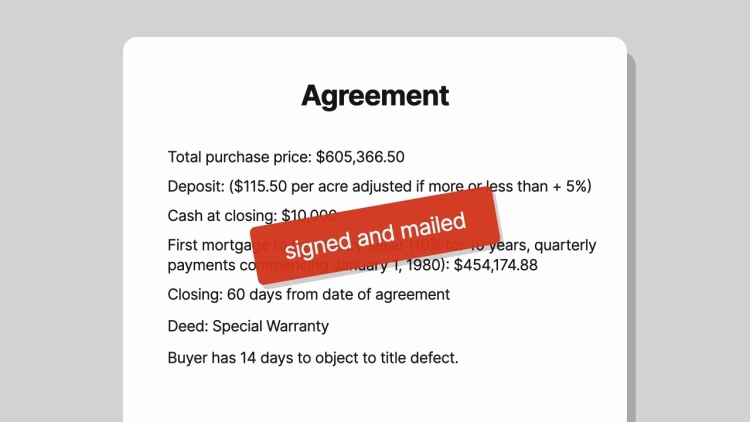
Vincent Benya (plaintiff) wanted to purchase 5,000 acres of timber land from Stevens and Thompson Paper Company, Inc. (S&T) (defendant). On September 24, 1979, Landvest, Inc., a real-estate-sales company, prepared a purchase-and-sales agreement that Benya signed and sent to S&T. S&T’s attorney made the following changes to the agreement: (1) deposit doubled from $5,000 to $10,000; (2) minimal adjustment of the per-acre price; (3) cash at closing reduced by $5,000; (4) mortgage percentage increased from 9 percent to 10 percent; (5) mortgage-commencement date moved back with quarterly, not annual payments; (6) deed type changed from warranty to special warranty. S&T’s vice president initialed each change, signed the agreement, and mailed it back to Landvest. Benya objected to the new deposit amount. Landvest spoke to S&T’s attorney and prepared a new agreement that reduced the deposit back to $5,000 and postponed the date of the first quarterly payment for one year. On October 19, Benya signed the document and in early November 1979, sent it to S&T for approval. S&T never executed it because it had sold the land on November 7. Benya brought a breach-of-contract complaint. Following a bench trial, the court found the September 24 agreement binding because both parties signed it and the terms were substantially the same. The court awarded Benya $300,000 in damages and $50,000 in punitive damages. S&T appealed.
Rule of Law
Issue
Holding and Reasoning (Billings, C.J.)
What to do next…
Here's why 964,000 law students have relied on our case briefs:
- Written by law professors and practitioners, not other law students. 47,500 briefs, keyed to 1,006 casebooks. Top-notch customer support.
- The right amount of information, includes the facts, issues, rule of law, holding and reasoning, and any concurrences and dissents.
- Access in your classes, works on your mobile and tablet. Massive library of related video lessons and high quality multiple-choice questions.
- Easy to use, uniform format for every case brief. Written in plain English, not in legalese. Our briefs summarize and simplify; they don’t just repeat the court’s language.
- AI-generated podcast version of every brief — listen on the go, between classes, or whenever reading isn’t an option. New
Understand your casebook readings in seconds
Use our case briefs to comprehend your casebook readings faster, supplement your notes and outlines, and outshine your peers in class.
Get instant access to over 47,500+ expert-written case briefs in a searchable database keyed to 1,006 law school casebooks.
