





In re Clark
United States Bankruptcy Court for the Western District of Pennsylvania
96 B.R. 605 (1989)

- Written by Douglas Halasz, JD
Facts
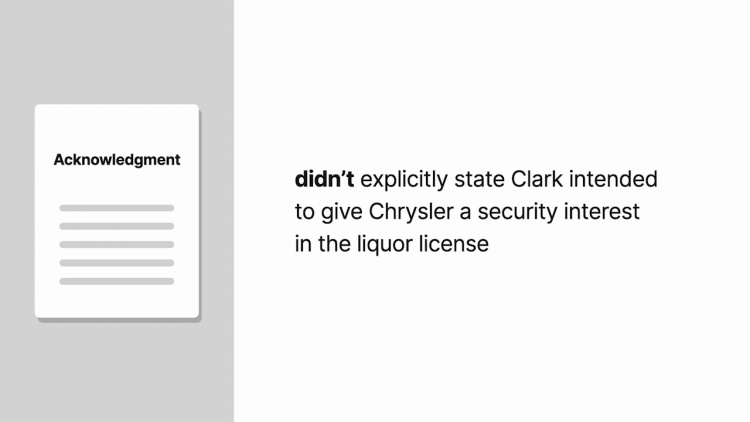
In 1986, Dick Clark (debtor) entered into a loan transaction with Chrysler First Consumer Discount Company (Chrysler) (creditor). Clark used the loaned funds to purchase a restaurant. To secure Clark’s repayment obligation, Chrysler had Clark execute a first mortgage in favor of Chrysler covering the premises purchased, as well as a second instrument titled “Acknowledgement.” The Acknowledgement referred exclusively to a liquor license (License) and indicated Clark’s consent that the License could not be removed from the premises nor transferred without Chrysler’s prior written consent until the mortgage was fully paid. Clark also signed a financing statement listing the License as additional collateral to secure repayment of the loan. In 1987, the Pennsylvania Legislature amended the liquor code to provide that a liquor license was to be treated as personal property as between the licensee and third parties. In 1988, Clark filed a Petition for Relief in the United States Bankruptcy Court for the Western District of Pennsylvania, thereby staying the enforcement of Chrysler’s asserted security interest. Chrysler filed a Motion for Relief of the Automatic Stay and Adequate Protection seeking determinations of whether the Acknowledgement sufficiently satisfied the formal requirements of an enforceable security agreement and whether Chrysler’s security interest attached when the legislature amended the liquor code.
Rule of Law
Issue
Holding and Reasoning (Bentz, J.)
What to do next…
Here's why 964,000 law students have relied on our case briefs:
- Written by law professors and practitioners, not other law students. 47,500 briefs, keyed to 1,006 casebooks. Top-notch customer support.
- The right amount of information, includes the facts, issues, rule of law, holding and reasoning, and any concurrences and dissents.
- Access in your classes, works on your mobile and tablet. Massive library of related video lessons and high quality multiple-choice questions.
- Easy to use, uniform format for every case brief. Written in plain English, not in legalese. Our briefs summarize and simplify; they don’t just repeat the court’s language.
- AI-generated podcast version of every brief — listen on the go, between classes, or whenever reading isn’t an option. New
Understand your casebook readings in seconds
Use our case briefs to comprehend your casebook readings faster, supplement your notes and outlines, and outshine your peers in class.
Get instant access to over 47,500+ expert-written case briefs in a searchable database keyed to 1,006 law school casebooks.
