In re King
United States Bankruptcy Court for the Northern District of Indiana
508 B.R. 71 (2014)
- Written by Abby Roughton, JD
Facts
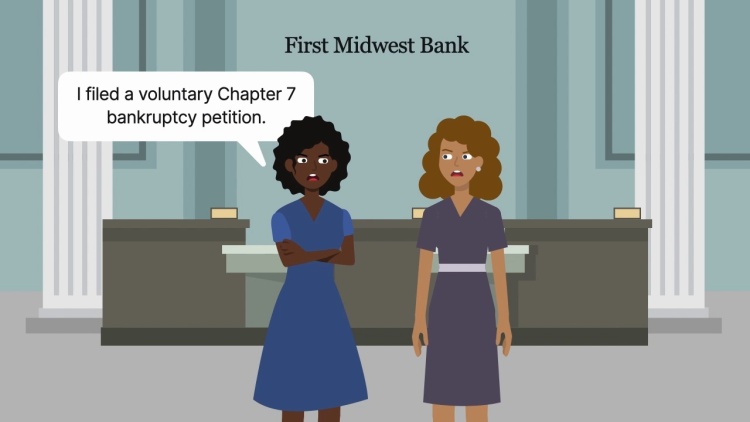
Margaret Naomi King (debtor) had her 2012 federal income-tax return filed by H&R Block Tax Group. The tax return claimed a refund of $8,548, which included an earned-income credit of $5,891. H&R Block created a refund-anticipation-check bank account for King’s benefit for the purpose of depositing King’s anticipated tax refund. After the refund was deposited in the account, H&R Block withdrew the amount of the tax-preparation fee that King owed and deposited the remaining $8,196.55 into King’s personal checking account. On February 13, 2013, $3,138.63 was frozen from King’s checking account as the result of a garnishment by one of King’s creditors. On March 22, 2013, King filed a voluntary petition for chapter 7 bankruptcy. After King filed the bankruptcy petition, King’s creditor requested that the frozen funds be released, and King took possession of the money. King claimed that the $3,138.63 was exempt from seizure under Indiana’s bankruptcy law, which exempts a debtor’s interest in a “refund or credit received or to be received” under the Internal Revenue Code’s earned-income-credit provision. King asserted that the $3,138.63 was the proceeds of the earned-income-credit portion of her tax refund. Kenneth Manning, the trustee of King’s bankruptcy estate, filed an objection to King’s claimed exemption. Manning asserted that the $3,138.63 was not from the earned-income credit and thus was the property of the bankruptcy estate. Manning claimed that when King’s tax refund was deposited into the bank account controlled by H&R Block, the funds stopped being a tax refund and instead became refund-anticipation-check funds that were paid to King by H&R Block.
Rule of Law
Issue
Holding and Reasoning (Klingeberger, J.)
What to do next…
Here's why 966,000 law students have relied on our case briefs:
- Written by law professors and practitioners, not other law students. 47,500 briefs, keyed to 1,007 casebooks. Top-notch customer support.
- The right amount of information, includes the facts, issues, rule of law, holding and reasoning, and any concurrences and dissents.
- Access in your classes, works on your mobile and tablet. Massive library of related video lessons and high quality multiple-choice questions.
- Easy to use, uniform format for every case brief. Written in plain English, not in legalese. Our briefs summarize and simplify; they don’t just repeat the court’s language.
- AI-generated podcast version of every brief — listen on the go, between classes, or whenever reading isn’t an option. New
Understand your casebook readings in seconds
Use our case briefs to comprehend your casebook readings faster, supplement your notes and outlines, and outshine your peers in class.
Get instant access to over 47,500+ expert-written case briefs in a searchable database keyed to 1,007 law school casebooks.