Levka v. City of Chicago
United States Court of Appeals for the Seventh Circuit
748 F.2d 421 (1984)

- Written by Josh Lee, JD
Facts
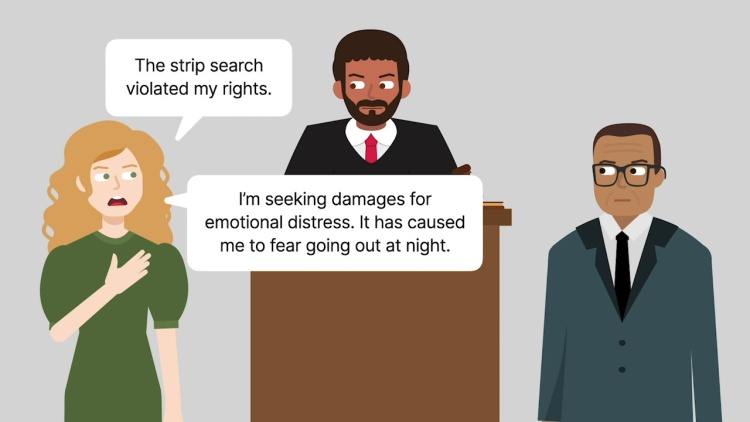
Levka (plaintiff) was arrested by Chicago police officers for a misdemeanor offense. By policy, the City of Chicago (the City) (defendant) strip searched every female arrestee at the jail regardless of the charge and regardless of whether the arrestee was actually suspected of possessing drugs or weapons. In accordance with this policy, Levka was strip searched when she arrived at the jail. Female correctional officers searched Levka in a jail cell. These officers were pleasant, matter-of-fact, and nonthreatening. In a separate case, the City’s policy regarding strip searches had been held to violate the Fourth and Fourteenth Amendment. Levka sued the City for violating her constitutional rights, pursuant to 42 U.S.C. § 1983. Levka testified that after the search, she felt debased and humiliated and degraded, abused, and misused. Levka was released from jail approximately an hour after the search. Levka testified that the search had lasting effects because she is afraid to go outside alone in the evenings. The City presented testimony that challenged Levka’s assertions regarding the inability to go outside alone at night. After a trial, the jury returned a verdict of $50,000 for Levka for emotional trauma and distress, mental and physical suffering, anguish, fear, humiliation and embarrassment. The City moved for a judgment notwithstanding the verdict or, in the alternative, a new trial or the entry of a remittitur. The trial court denied the City’s motion, and the City appealed to the United States Court of Appeals for the Seventh Circuit.
Rule of Law
Issue
Holding and Reasoning (Pell, J.)
What to do next…
Here's why 964,000 law students have relied on our case briefs:
- Written by law professors and practitioners, not other law students. 47,500 briefs, keyed to 1,006 casebooks. Top-notch customer support.
- The right amount of information, includes the facts, issues, rule of law, holding and reasoning, and any concurrences and dissents.
- Access in your classes, works on your mobile and tablet. Massive library of related video lessons and high quality multiple-choice questions.
- Easy to use, uniform format for every case brief. Written in plain English, not in legalese. Our briefs summarize and simplify; they don’t just repeat the court’s language.
- AI-generated podcast version of every brief — listen on the go, between classes, or whenever reading isn’t an option. New
Understand your casebook readings in seconds
Use our case briefs to comprehend your casebook readings faster, supplement your notes and outlines, and outshine your peers in class.
Get instant access to over 47,500+ expert-written case briefs in a searchable database keyed to 1,006 law school casebooks.