Mills v. Alabama
United States Supreme Court
384 U.S. 214 (1966)
- Written by Heather Whittemore, JD
Facts
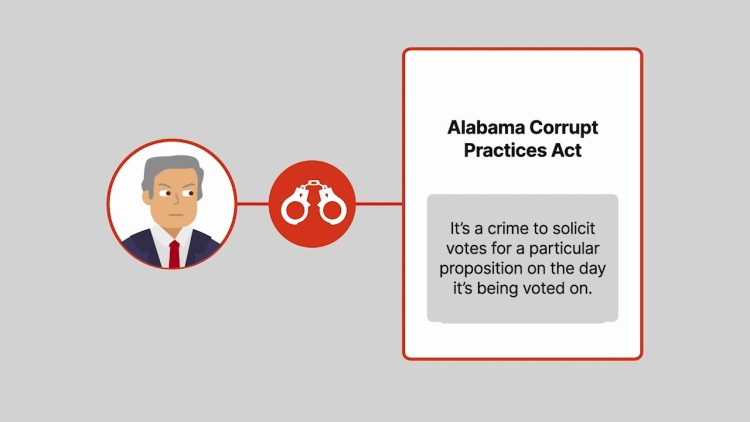
The Alabama Corrupt Practices Act (the statute) made it illegal to solicit votes for or against a ballot initiative on election day. The statute was meant to maintain peace and order on election day by preventing any last-minute distribution of propaganda. The Birmingham Post-Herald, a newspaper edited by James E. Mills (defendant), published an editorial on election day asking readers to vote for a ballot initiative to replace the Birmingham city commission with a mayor-council system. Mills was arrested for violating the statute. Mills argued that the statute violated the freedom of the press. The trial court granted a demurrer on the criminal complaint before trial, which would have dismissed the case. Alabama (plaintiff) appealed. The Alabama Supreme Court reversed the trial court, holding instead that the statute was a reasonable restriction and limited the press to an acceptably small extent. Mills appealed.
Rule of Law
Issue
Holding and Reasoning (Black, J.)
Concurrence (Douglas, J.)
Dissent (Harlan, J.)
What to do next…
Here's why 956,000 law students have relied on our case briefs:
- Written by law professors and practitioners, not other law students. 47,500 briefs, keyed to 1,006 casebooks. Top-notch customer support.
- The right amount of information, includes the facts, issues, rule of law, holding and reasoning, and any concurrences and dissents.
- Access in your classes, works on your mobile and tablet. Massive library of related video lessons and high quality multiple-choice questions.
- Easy to use, uniform format for every case brief. Written in plain English, not in legalese. Our briefs summarize and simplify; they don’t just repeat the court’s language.
- AI-generated podcast version of every brief — listen on the go, between classes, or whenever reading isn’t an option. New