The United States v. The Libellants and Claimants of the Schooner Amistad
United States Supreme Court
40 U.S. 518 (1841)
- Written by Tammy Boggs, JD
Facts
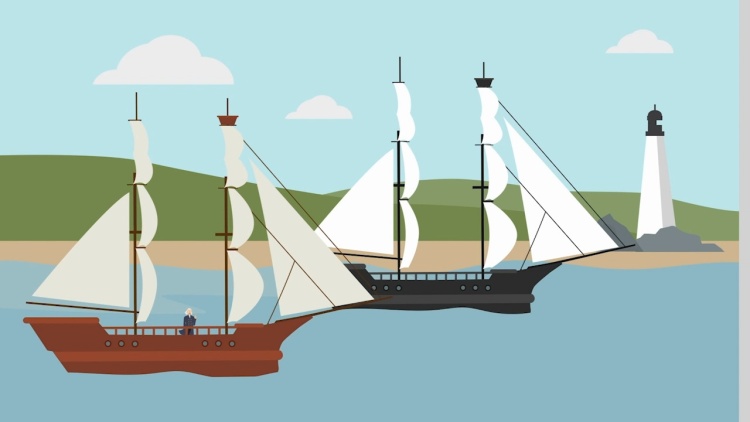
Several Spanish citizens boarded a ship, the Amistad, and departed a Cuban port with a group of Africans. The Spaniards claimed their entitlement to transport the Africans as slaves and possessed some kind of written authorization signed by a Cuban official. At sea, the Africans revolted and took control of the ship. About a month later, the Amistad was found off the coast of New York by an American naval officer who seized the ship and brought the parties before the United States District Court. In relevant court proceedings, the Spaniards asserted ownership over the Africans as slaves. The United States intervened on behalf of the Spaniards, solely seeking restitution of Spanish property based on American treaty obligations. The Africans responded that they were not slaves but free people, kidnapped in Africa, and unlawfully transported away from their home country, i.e., victims of illegal slave trading. The district court found in favor of the Africans, declared them free, and ordered them returned to the coast of Africa. (Under both American and Spanish law at the time, slave trading was prohibited. In the United States, illegally imported slaves were transported to the coast of Africa.) The United States appealed to the Circuit Court, which affirmed, and then appealed to the United States Supreme Court.
Rule of Law
Issue
Holding and Reasoning (Story, J.)
What to do next…
Here's why 955,000 law students have relied on our case briefs:
- Written by law professors and practitioners, not other law students. 47,500 briefs, keyed to 1,006 casebooks. Top-notch customer support.
- The right amount of information, includes the facts, issues, rule of law, holding and reasoning, and any concurrences and dissents.
- Access in your classes, works on your mobile and tablet. Massive library of related video lessons and high quality multiple-choice questions.
- Easy to use, uniform format for every case brief. Written in plain English, not in legalese. Our briefs summarize and simplify; they don’t just repeat the court’s language.
- AI-generated podcast version of every brief — listen on the go, between classes, or whenever reading isn’t an option. New