





United States v. Doremus
United States Supreme Court
249 U.S. 86 (1919)
- Written by Salina Kennedy, JD
Facts
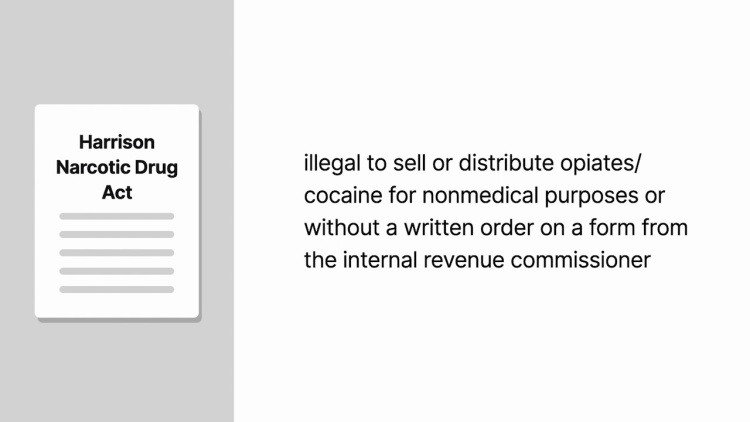
The Harrison Narcotic Drug Act (Harrison Act) was a federal law that required sellers and distributors of narcotics to register with the collector of internal revenue and to pay a special tax of one dollar per year. The Harrison Act also prohibited the sale or distribution of narcotics to a recipient who did not have a written order on a form provided by the commissioner of internal revenue, as well as the sale or distribution of narcotics for nonmedical purposes. Doremus (defendant) was convicted of violating the Harrison Act because he provided heroin to Ameris, a drug addict, without the required written order and without a medical purpose. Doremus challenged the indictment, and the district court held that the Harrison Act was unconstitutional. The court reasoned that the true purpose of the Harrison Act was not to collect revenue but to regulate drugs, part of the police power reserved to the states, and that because Congress had enacted the Harrison Act in an attempt to exert a power not delegated to it, the act was unconstitutional. The United States (plaintiff) appealed.
Rule of Law
Issue
Holding and Reasoning (Day, J.)
Dissent (White, C.J.)
What to do next…
Here's why 955,000 law students have relied on our case briefs:
- Written by law professors and practitioners, not other law students. 47,500 briefs, keyed to 1,006 casebooks. Top-notch customer support.
- The right amount of information, includes the facts, issues, rule of law, holding and reasoning, and any concurrences and dissents.
- Access in your classes, works on your mobile and tablet. Massive library of related video lessons and high quality multiple-choice questions.
- Easy to use, uniform format for every case brief. Written in plain English, not in legalese. Our briefs summarize and simplify; they don’t just repeat the court’s language.
- AI-generated podcast version of every brief — listen on the go, between classes, or whenever reading isn’t an option. New
