





From our private database of 47,500+ case briefs, written and edited by humans—never with AI.
Katz v. United States
United States Supreme Court
389 U.S. 347, 88 S. Ct. 507, 19 L. Ed. 2D 576 (1967)

- Written by Rich Walter, JD
Facts
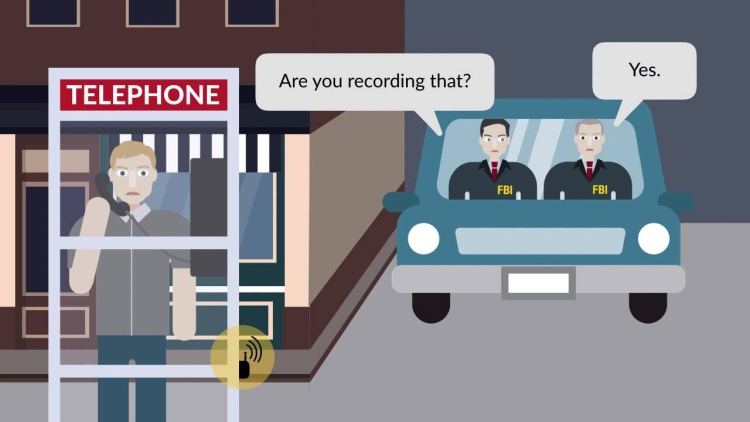
Federal agents attached an electronic-eavesdropping device to the exterior of a transparent glass-enclosed public telephone booth frequented by Charles Katz (defendant). The agents used this device to conduct a warrantless wiretap of Katz’s phone conversations and collect incriminating evidence, which the government used to prosecute and convict Katz for wire fraud. A circuit court affirmed the conviction, ruling there had been no Fourth Amendment violation because the agents never physically entered space occupied by Katz. The United States Supreme Court granted certiorari to reconsider the Fourth Amendment issue.
Rule of Law
Issue
Holding and Reasoning (Stewart, J.)
Concurrence (Harlan, J.)
Concurrence (Douglas, J.)
Concurrence (White, J.)
Dissent (Black, J.)
What to do next…
Here's why 955,000 law students have relied on our case briefs:
- Written by law professors and practitioners, not other law students. 47,500 briefs, keyed to 1,006 casebooks. Top-notch customer support.
- The right amount of information, includes the facts, issues, rule of law, holding and reasoning, and any concurrences and dissents.
- Access in your classes, works on your mobile and tablet. Massive library of related video lessons and high quality multiple-choice questions.
- Easy to use, uniform format for every case brief. Written in plain English, not in legalese. Our briefs summarize and simplify; they don’t just repeat the court’s language.
- AI-generated podcast version of every brief — listen on the go, between classes, or whenever reading isn’t an option. New
