Wood v. Lucy, Lady Duff-Gordon
New York Court of Appeals
118 N.E. 214, 222 N.Y. 88 (1917)
- Written by Jamie Milne, JD
Facts
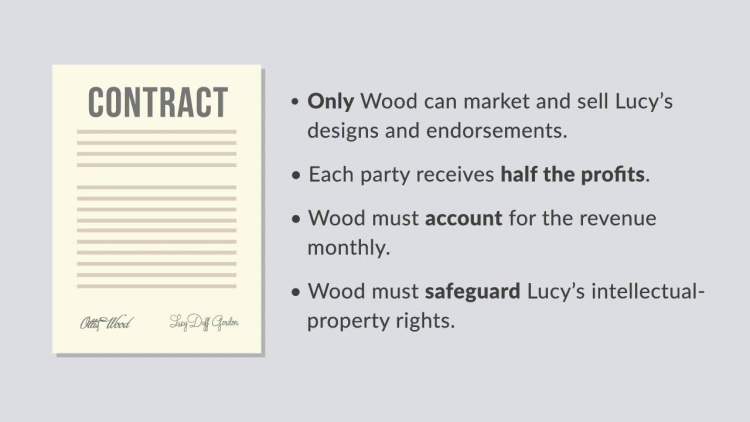
Well-known fashion designer Lucy, Lady Duff-Gordon (defendant) entered an agreement with Otis Wood (plaintiff), whereby Duff-Gordon granted Wood the exclusive rights to place Duff-Gordon’s endorsement on others’ designs and to market and sell Duff-Gordon’s own designs. The exclusive rights were to last for at least one year and renew annually until terminated. In exchange for granting the exclusive rights, Duff-Gordon was to receive 50 percent of all profits from Wood’s activities concerning Duff-Gordon’s endorsements and designs. Wood agreed to keep records of all accounts and to obtain any patents, copyrights, and trademarks necessary to protect Duff-Gordon’s designs. When Duff-Gordon later contracted with another company to place her endorsement on designs and kept the profits for herself, Wood sued Duff-Gordon for breach of contract. He argued that Duff-Gordon had breached Wood’s exclusive right to place Duff-Gordon’s endorsement on others’ designs. Duff-Gordon filed a motion for demurrer, arguing that the agreement with Wood was not an enforceable contract because it did not obligate Wood to perform any act and the contract therefore lacked consideration. The trial court denied the motion. The appellate division reversed, entering judgment for Duff-Gordon. Wood appealed to the New York Court of Appeals.
Rule of Law
Issue
Holding and Reasoning (Cardozo, J.)
What to do next…
Here's why 961,000 law students have relied on our case briefs:
- Written by law professors and practitioners, not other law students. 47,500 briefs, keyed to 1,006 casebooks. Top-notch customer support.
- The right amount of information, includes the facts, issues, rule of law, holding and reasoning, and any concurrences and dissents.
- Access in your classes, works on your mobile and tablet. Massive library of related video lessons and high quality multiple-choice questions.
- Easy to use, uniform format for every case brief. Written in plain English, not in legalese. Our briefs summarize and simplify; they don’t just repeat the court’s language.
- AI-generated podcast version of every brief — listen on the go, between classes, or whenever reading isn’t an option. New