World-Wide Volkswagen Corp. v. Woodson
United States Supreme Court
444 U.S. 286, 100 S. Ct. 559, 62 L. Ed. 2d 490 (1980)
- Written by Jamie Milne, JD
Facts
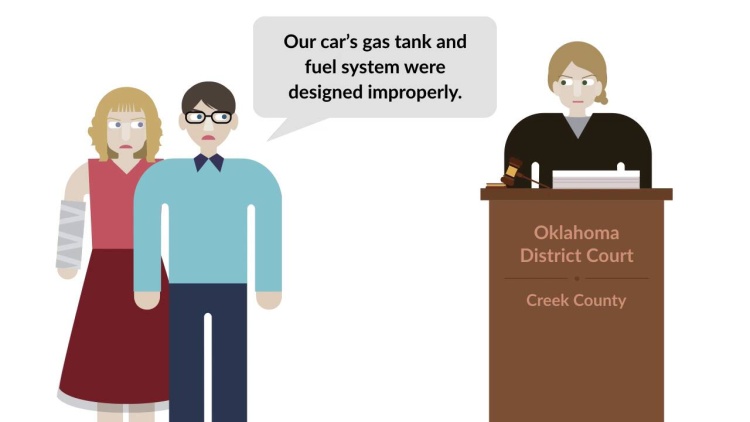
New York residents Harry and Kay Robinson (plaintiffs) purchased a car from Seaway Volkswagen (Seaway) (defendant), a New York automobile retailer. The next year, the Robinson family moved to Arizona. While driving to Arizona, the Robinsons were struck by another car in Oklahoma. The Robinsons’ car caught fire, severely burning Kay Robinson and her children. The Robinsons brought a products-liability suit in Oklahoma state court against multiple parties, including Seaway and World-Wide Volkswagen (World-Wide) (defendant), a northeast regional vehicle distributor that had supplied the Robinsons’ car to Seaway. The Robinsons claimed that the fire resulted from the defective design of the car’s fuel system. Seaway and World-Wide made a special appearance in the trial court, arguing that Oklahoma’s exercise of personal jurisdiction over Seaway and World-Wide would violate constitutional due process because the companies were not located in Oklahoma, did not do any business in Oklahoma, and did not advertise to Oklahoma residents. The trial court disagreed, holding that it could exercise personal jurisdiction over Seaway and World-Wide. Seaway and World-Wide then sought a writ of prohibition in the Oklahoma Supreme Court to stop trial judge Charles Woodson from exercising personal jurisdiction over them. The Oklahoma Supreme Court denied the writ, approving personal jurisdiction because it was foreseeable that Seaway’s and World-Wide’s automobiles might be used in Oklahoma. The United States Supreme Court granted certiorari.
Rule of Law
Issue
Holding and Reasoning (White, J.)
Dissent (Brennan, J.)
What to do next…
Here's why 954,000 law students have relied on our case briefs:
- Written by law professors and practitioners, not other law students. 47,500 briefs, keyed to 1,006 casebooks. Top-notch customer support.
- The right amount of information, includes the facts, issues, rule of law, holding and reasoning, and any concurrences and dissents.
- Access in your classes, works on your mobile and tablet. Massive library of related video lessons and high quality multiple-choice questions.
- Easy to use, uniform format for every case brief. Written in plain English, not in legalese. Our briefs summarize and simplify; they don’t just repeat the court’s language.
- AI-generated podcast version of every brief — listen on the go, between classes, or whenever reading isn’t an option. New