




Williams Companies Stockholders Litigation
Delaware Chancery Court
2021 WL 754593 (2021)
- Written by Alexander Hager-DeMyer, JD
Facts
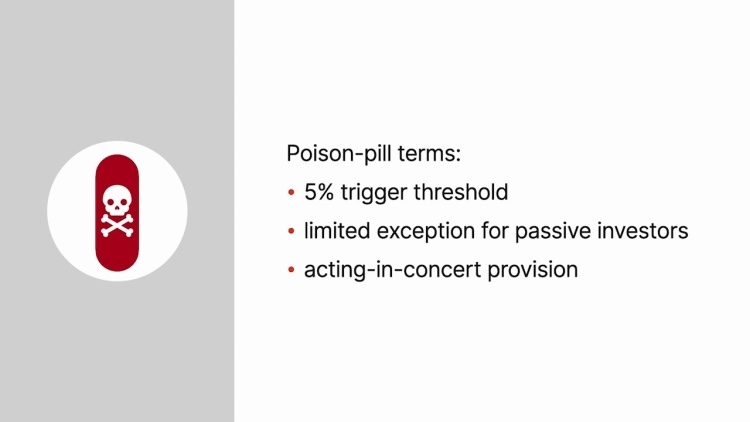
The Williams Companies, Inc. (Williams) (defendant) was a publicly traded corporation that owned and operated natural gas infrastructure assets like pipelines and processing facilities. Williams was overseen by a board of directors (defendants). In response to the COVID-19 pandemic and an oil-price war, Williams stock prices dropped substantially. As a result, Williams’s board of directors considered implementing a poison pill, or shareholder-rights plan, to protect the company from potential stockholder activism. Two of Williams’s 12 directors had encountered investors who engaged in stockholder activism by acquiring Williams stock, becoming board members, and then attempting to forcibly change the board’s membership. The board met twice to consider the terms of the poison pill and was advised by outside legal and financial advisors. The board did not discuss Williams’s previous encounters with stockholder activism. After deliberating, the board implemented a poison pill with several features, including a 5 percent beneficial-ownership trigger threshold, a limited exception for passive investors, and an acting-in-concert provision. These terms were more intensive and extreme than similar plans currently in effect with other companies. The board further failed to redeem the plan, leaving it in place. In response to the plan, a class of Williams shareholders filed suit in Delaware Chancery Court, claiming that the board members breached their fiduciary duties by adopting and maintaining the shareholder-rights plan. During trial, the board identified three reasons for adopting the plan: (1) a generalized concern about potential stockholder activism; (2) a concern that activists could pursue short-term agendas without caring about the long-term company health; and (3) a desire to detect attempts by activists to rapidly accumulate substantial amounts of stock, known as lightning-strike attacks.
Rule of Law
Issue
Holding and Reasoning (McCormick, J.)
What to do next…
Here's why 964,000 law students have relied on our case briefs:
- Written by law professors and practitioners, not other law students. 47,500 briefs, keyed to 1,006 casebooks. Top-notch customer support.
- The right amount of information, includes the facts, issues, rule of law, holding and reasoning, and any concurrences and dissents.
- Access in your classes, works on your mobile and tablet. Massive library of related video lessons and high quality multiple-choice questions.
- Easy to use, uniform format for every case brief. Written in plain English, not in legalese. Our briefs summarize and simplify; they don’t just repeat the court’s language.
- AI-generated podcast version of every brief — listen on the go, between classes, or whenever reading isn’t an option. New
Understand your casebook readings in seconds
Use our case briefs to comprehend your casebook readings faster, supplement your notes and outlines, and outshine your peers in class.
Get instant access to over 47,500+ expert-written case briefs in a searchable database keyed to 1,006 law school casebooks.