



Play video

Tax-Exempt Status

Learn about how healthcare entities qualify for and maintain tax-exempt status and tax-exemption issues for multi-entity healthcare systems.

Transcript

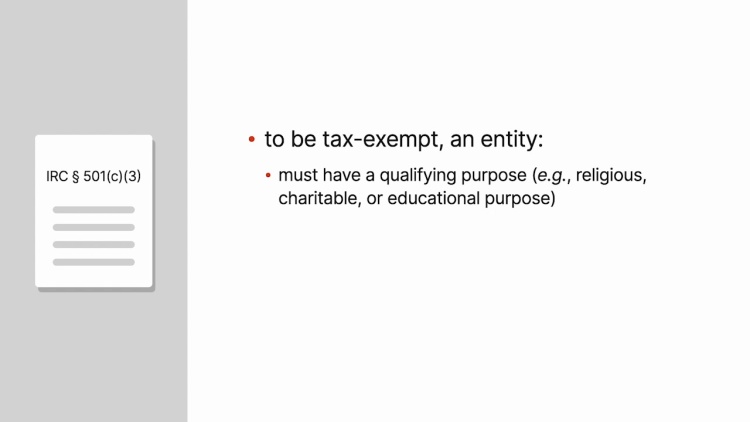
Nonprofit and government-owned healthcare entities may qualify to be tax-exempt under federal law. Qualifying for tax-exempt status provides many benefits. One of the most significant benefits is not having to pay federal income tax. A tax-exempt status also makes fundraising easier because the entity may be able to issue tax-exempt bonds, and donations to the entity are tax deductible for the donors.

To qualify for federal tax exemption, a healthcare entity must satisfy the requirements set...

The field below filters the lessons in this course as you type. The number of matching lessons is announced as you type.

Lessons

1. Welcome
  • Welcome to Healthcare Law
2. Health Insurance
  • Medicare
  • Medicaid
  • Private Rights Enforcement
  • ERISA
  • ERISA Preemption and Remedies
  • ERISA Remedies and ACA Reforms
3. The Structure of Healthcare Entities
  • The Professional Workforce
  • Forming a Healthcare Entity
  • Fiduciary Duties at Healthcare Entities
  • Tax-Exempt Status
  • Joint Ventures and Tax-Exempt Status
4. Fraud and Abuse in Healthcare
  • The False Claims Act
  • The Anti-Kickback Statute
  • Stark Law
  • Enforcement Mechanisms
  • Qui Tam Actions
5. Antitrust Issues in Healthcare
  • Overview of Antitrust Laws in Healthcare
  • Mergers and Acquisitions in Healthcare
  • Working with Competitors
  • Payers with Market Power
6. Tort Liability of Healthcare Entities
  • The Physician-Patient Relationship
  • Physician Duties Regarding Information
  • Physician Duties Regarding Clinical Care
  • Hospital and Health Plan Liability
7. Recurring Legal Issues in Patient Care
  • Reproduction and Birth
  • Organ Transplantation
  • Research Involving Human Subjects
  • The End of Life
  • Health Privacy
  • Discrimination in Healthcare
8. Public Health Law
  • The Police Power
  • Free Exercise Challenges
  • Noncommunicable Conditions