



Play video

Insurer’s Duty to Defend

Learn about an insurance company’s rights and obligations to defend an insured from liability and how coverage disputes impact those rights and obligations.

Transcript

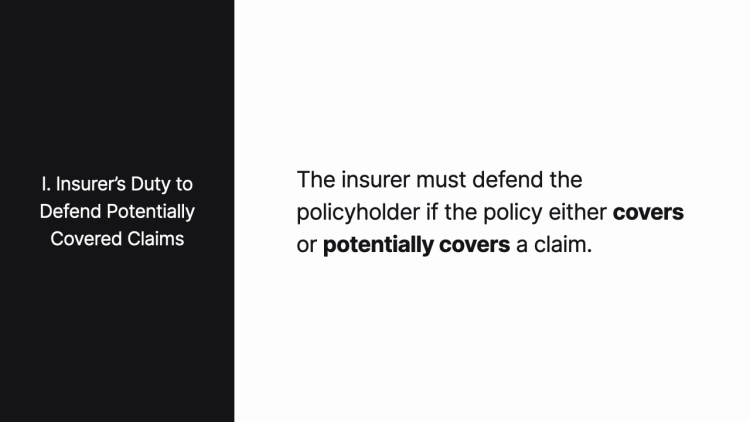
Liability insurance is third-party insurance, which means it protects a policyholder from claims by third parties. Liability insurance provides this protection in two ways. First, the insurer defends the policyholder against third-party claims. Second, the insurer indemnifies the policyholder by paying the cost of claim judgments or settlements. In this lesson, we’ll look at the first protection: the insurer’s duty to defend the policyholder. Indemnity coverage is discussed in a separate...

Lessons

1. Welcome to Insurance Law
  • Welcome to Insurance Law
2. Insurance Basics
  • Fundamental Insurance Principles
  • Laws Governing Insurance
  • Types of Insurance
3. The Insurance Policy
  • Forming An Insurance Contract or Policy
  • Interpreting Policy Terms: General Principles
  • Interpreting Policy Terms: Plain Meaning and Ambiguity
  • Policyholder Claims and Remedies for Policy Disputes
  • Insurance Company’s Policy Rights and Remedies
4. Property (First-Party) Insurance
  • Property Insurance Coverage
  • Property Insurance Conditions, Exclusions, and Limits
  • Property Loss Claims
5. CGLs and Liability (Third-Party) Insurance
  • Claims Covered by Liability Insurance
  • Liability Insurance Conditions and Exclusions
  • Insurer’s Duty to Defend
  • Claim Settlement and Insurer Duty to Indemnify
  • Coverage from Multiple Liability Policies
6. Specific Types of Insurance
  • Homeowners’ and Renters’ Insurance
  • Automobile Insurance
  • Life Insurance
  • Disability Insurance
  • Health Insurance
  • Excess Insurance
  • Reinsurance