



Play video

Allowance and Disallowance of Claims

Learn about the general rules governing whether the bankruptcy court should allow or disallow a creditor's claim, along with the consequences of allowance and disallowance.

Transcript

As we've mentioned, a claim is any right to payment, regardless whether it's secured, unsecured, liquidated, unliquidated, matured, unmatured, contingent, fixed, disputed, undisputed, legal, equitable, and so on. Having a claim against the debtor is the foundation of a creditor's right to participate and, less commonly, receive a distribution in a bankruptcy case.

I. Proof of Claim

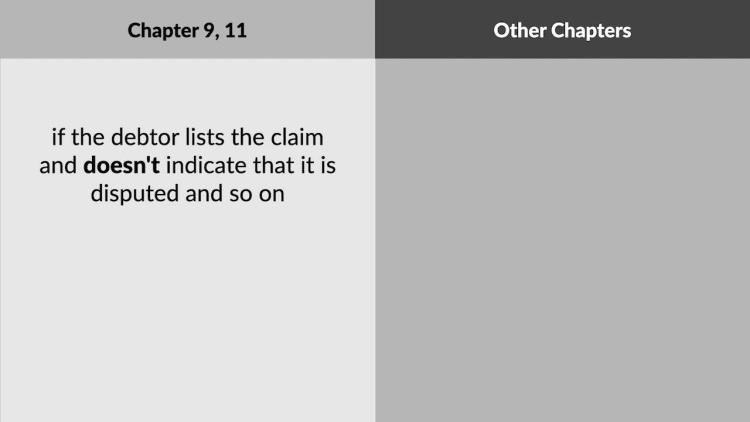
More precisely, for a creditor to be treated as a creditor in the bankruptcy case, it must have...

Lessons

1. Welcome to Bankruptcy
5. Chapter 7 Liquidation
  • Chapter 7 Panel Trustee
  • Distribution of Estate Property in Chapter 7
  • Discharge in Chapter 7
  • Personal-Property Collateral in Chapter 7
  • General Grounds to Dismiss a Chapter 7 Case
  • Introduction to the Means Test and Dismissals or Conversions for Abuse
6. Debt Adjustment in Chapter 13
  • Eligibility to File for Chapter 13
  • The Estate in Chapter 13
  • Introduction to the Chapter 13 Plan of Debt Adjustment
  • Terms Permitted in a Chapter 13 Plan
  • Chapter 13 Confirmation Requirements: Treatment of Secured Claims
  • Chapter 13 Confirmation Requirements: Treatment of Unsecured and Priority Claims
7. Preferences
  • Introduction to Preferences
  • A Transfer to a Creditor or for a Creditor's Benefit Made for or on Account of an Antecedent Debt
  • A Transfer Enabling a Creditor to Receive More Than It Would in Chapter 7
  • The Net-Benefit Rule
  • Contemporaneous Exchanges for New Value
  • Transfers in the Ordinary Course of Business
  • Subsequent New Value