



Play video

Chapter 13 Confirmation Requirements: Treatment of Unsecured and Priority Claims

Learn how the chapter 13 plan must treat priority and general unsecured claims to be confirmed, including the requirement that the debtor commit all projected disposable income over the applicable commitment period to general unsecured claims.

Transcript

For the bankruptcy court to confirm a chapter 13 plan, the plan must satisfy many exacting statutory requirements. Among these are rules for how the plan must treat general unsecured claims and priority unsecured claims. We'll cover some of these rules here.

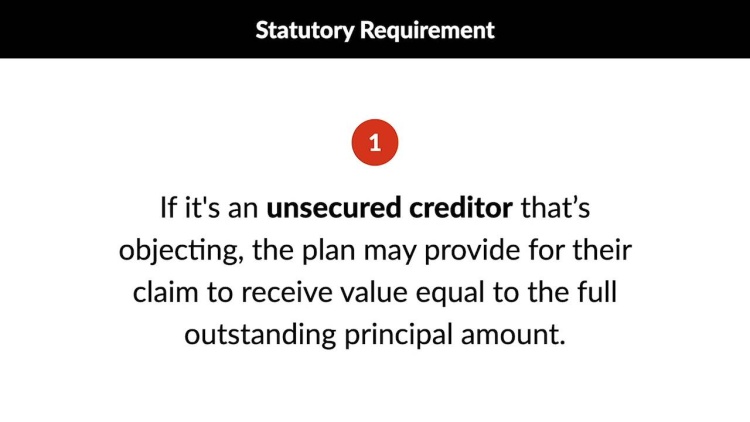
For starters, if and only if the standing trustee or a general unsecured creditor objects, then the plan must satisfy one of the following two requirements to be confirmed.

I. Paying an Objecting Unsecured Creditor's Claim in Full

Number...

Lessons

1. Welcome to Bankruptcy
5. Chapter 7 Liquidation
  • Chapter 7 Panel Trustee
  • Distribution of Estate Property in Chapter 7
  • Discharge in Chapter 7
  • Personal-Property Collateral in Chapter 7
  • General Grounds to Dismiss a Chapter 7 Case
  • Introduction to the Means Test and Dismissals or Conversions for Abuse
6. Debt Adjustment in Chapter 13
  • Eligibility to File for Chapter 13
  • The Estate in Chapter 13
  • Introduction to the Chapter 13 Plan of Debt Adjustment
  • Terms Permitted in a Chapter 13 Plan
  • Chapter 13 Confirmation Requirements: Treatment of Secured Claims
  • Chapter 13 Confirmation Requirements: Treatment of Unsecured and Priority Claims
7. Preferences
  • Introduction to Preferences
  • A Transfer to a Creditor or for a Creditor's Benefit Made for or on Account of an Antecedent Debt
  • A Transfer Enabling a Creditor to Receive More Than It Would in Chapter 7
  • The Net-Benefit Rule
  • Contemporaneous Exchanges for New Value
  • Transfers in the Ordinary Course of Business
  • Subsequent New Value